· 3358 words · 17 min
🔐 Ryder Wallet Review 2026 — The First Seedless Hardware Wallet (Shamir's Secret Sharing Explained)
Hands-on Ryder Wallet review 2026 — seedless hardware wallet using Shamir's Secret Sharing instead of 24-word backup phrases. Tap-to-sign via NFC, TapSafe for existing seed phrase users, Secure Element chip. Affiliate disclosure inside.
Honest review. Some links are affiliate links: same price for you, a small commission for the project.
⚡ Quick answer — should you buy it?
If you've ever stared at a 24-word seed phrase, wondered what happens when you eventually lose the paper, and concluded that self-custody UX hasn't really improved since 2017 — Ryder is the first hardware wallet that meaningfully changes the recovery model, not just the form factor.
The headline feature is the Ryder Recovery Network: Shamir's Secret Sharing replaces the single seed phrase with encrypted fragments distributed across your phone, recovery tags, and (optionally) trusted contacts. Lose the device — tap your phone and a tag, you're back in. Lose everything — your trusted circle can restore access. There's no piece of paper that can ruin your day.
By 2026 Ryder One added the credibility layer that was missing at launch: the device won the Red Dot Product Design Award, passed a full independent security audit by Halborn, and the entire TapSafe recovery component is open source. The firmware now supports the top 60+ tokens across Ethereum and Solana, with native cross-chain swaps built into the app.
🔐 Get Ryder via my partner link
⚠️ Disclosure: this article contains an affiliate link to Ryder. If you purchase via the link above, I may earn a commission at no extra cost to you. This is informational content, not financial advice. Always do your own research on any hardware wallet before storing significant capital.
🏆 What's new in 2026 — credibility milestones
Ryder shipped four substantial updates that should change how you evaluate this device versus established hardware wallets:
-
Red Dot Product Design Award 2026 — Ryder One won the Red Dot Award, one of the most prestigious industrial-design honors in the world (jury benchmark since 1955; past winners include Apple, Porsche, Dyson). For a category dominated by USB-stick aesthetics, this is the first hardware wallet that competes on design at the same tier as premium consumer electronics.
-
Independent Halborn security audit (Oct 28 – Dec 5, 2025) — Halborn is one of the most trusted blockchain cybersecurity firms (prior audits on major DeFi protocols and hardware infrastructure). Their published conclusion confirmed the firmware implements hardware-wallet functionality with a solid cryptographic foundation. Ryder also open-sourced the TapSafe component on the back of this audit.
-
Ryder OS 1.6.0 + App 1.5.0 (April 2026) — added native cross-chain swaps inside the Ryder app (powered by Swaps.xyz), plus the ability to import existing 12 or 24-word seed phrases from Ledger / Trezor / Tangem and layer TapSafe backups on top without abandoning your old recovery path.
-
60+ tokens supported — top ERC-20s (USDT, UNI, PEPE among others) and top Solana SPL tokens now covered. Random passcode screen + improved welcome UX added in the same window.
The combined effect: Ryder went from "new vendor with interesting recovery idea" to "audited, award-winning, open-source-recovery hardware wallet with cross-chain swap built in" inside six months. The competitive picture against Ledger and Trezor changed materially.
📊 Public credibility: 4.8 / 5 on Trustpilot · shipped to 40+ countries · zero hacks on record · backed by Tim Draper (Draper Associates), Anatoly Yakovenko (founder of Solana) and Muneeb Ali (founder of Stacks).
🩸 Why seed phrases are an outdated UX problem?
Let's be honest about the system most of crypto still runs on. You buy a hardware wallet, the device generates a private key, and the wallet hands you 24 random English words and tells you to hide them somewhere safe — and never to type them into anything that has internet access.
That's the entire recovery system. If your house burns down with the paper inside, the assets are gone. If you photograph the paper "just for backup" and your phone gets compromised, the assets are gone. If you stamp the words onto a metal plate and lose it in a move, the assets are gone. If you die without telling anyone where it is, your family inherits nothing.
This is a single point of failure dressed up as security. It was acceptable in 2017 when crypto was a hobby for technical users who understood the trade-off. In 2026, when the average person holding crypto isn't a developer and the median portfolio is meaningful capital, telling someone "hide these 24 words and never lose them" is asking for catastrophic failures.
The smart-money direction has been pointing at this problem for two years — account abstraction on smart-contract wallets, MPC custody at exchanges, social recovery in Argent. The missing piece was a hardware wallet that fixed the recovery model without giving up cold-storage security. That's what Ryder shipped.
🔐 How Shamir's Secret Sharing actually works
The cryptographic primitive behind Ryder isn't new — Shamir's Secret Sharing was published by Adi Shamir in 1979. It's the same Shamir as the "S" in RSA, and the algorithm has been used in enterprise key management for decades. Ryder is the first hardware wallet to bring it to consumer-grade self-custody.
The idea: split a secret into N encrypted fragments, where any K of them (K ≤ N) can reconstruct the original, but fewer than K reveal nothing useful. You can lose up to N − K fragments without losing the secret. An attacker who steals fewer than K fragments learns nothing.
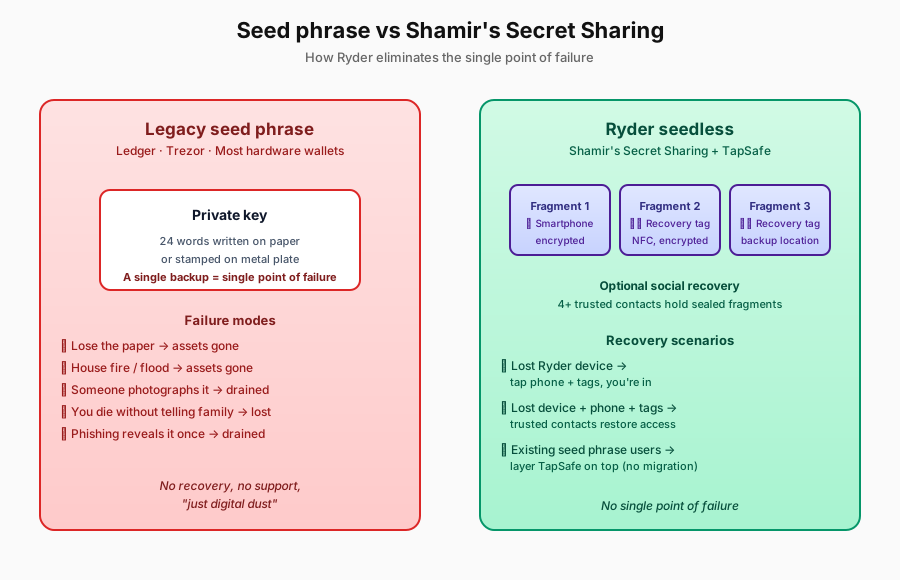
When you set up Ryder, your private key is never displayed as a list of words. The device generates the key inside a Secure Element chip, splits it into encrypted fragments using Shamir's algorithm, and distributes them across:
- Your smartphone — paired via the Ryder app
- One or more recovery tags — physical NFC tags that ship with the device
- Optionally, trusted contacts — for social recovery in worst-case scenarios
The default recovery configuration requires your phone plus a tag — losing one isn't catastrophic, losing both at once is. The optional social recovery raises the bar further: your trusted circle each holds a sealed fragment, and four or more participating together can restore access even if every personal backup is destroyed.
🛡️ The Ryder Recovery Network in practice
Default recovery — most users live here:
You set up the device, the app walks you through pairing your phone and configuring the recovery tags. You store one tag at home, one at a parents' place or a safety deposit box. If your Ryder device is lost, stolen, or destroyed, you buy a new one, open the app, tap your phone and a tag — keys are reconstructed and you're transacting again within minutes.
This single change — replacing "find the paper you hid years ago" with "tap two things you actually use" — eliminates the most common failure mode of hardware wallets.
Social recovery — the catastrophic-loss fallback:
The optional second layer is for the scenarios where you lose everything: device, phone, tags, in a single event. You designate four or more trusted contacts during setup. Each receives a sealed cryptographic fragment they store on their own phone (the fragment is useless individually — they can't access your wallet, and they can't even prove they hold a fragment of yours without your participation).
In a worst-case recovery, four contacts coordinate to provide their fragments, and your wallet is restored. This is the same threshold-secret mechanism used in enterprise custody, scaled down to consumer hardware.
The cryptographic property that matters: at no point in either recovery flow does the full private key exist in one place outside the Secure Element. Fragments are useless individually, the reconstruction happens on-device, and the chip never exposes the key in plaintext.
🎥 Watch TapSafe in action
📊 TapSafe vs seed phrase vs PIN-protected cards — head-to-head
Not all recovery methods protect you the same way. Here's how TapSafe compares against the two most common alternatives — the traditional seed phrase and PIN-protected metal recovery cards.
| Recovery method | TapSafe (Ryder One) | Seed phrase | PIN-protected cards |
|---|---|---|---|
| What you must remember | ✅ Nothing | ❌ Its location | ❌ A PIN code |
| If someone finds it | ✅ Useless on its own | ❌ Full access to your wallet | ❌ 3 wrong PINs = erased |
| Risk of mistakes | ✅ No risk | ❌ Risk of mistyping during recovery | ❌ Risk of losing the PIN |
| Durability | ✅ Resistant to dust & water | ❌ Fragile paper | ✅ Resistant to dust & water |
| Single point of failure | ✅ No — fragments distributed | ❌ Yes — one piece of paper | ❌ Yes — PIN required |
The TapSafe column wins on three out of four metrics outright and ties on durability. The seed phrase column loses on every metric except the one where it's already failing for most users in practice — "remembering where you hid it." PIN-protected cards (Tangem-style) improve durability but reintroduce a memorization problem and a hard ceiling at three wrong attempts before the device is erased.
This is the comparison Ryder is built around — and after a year of real-world deployment with a 4.8 Trustpilot rating and zero hacks on record, the model holds up empirically as well as on paper.
🎨 Hardware design — Red Dot Award 2026
The physical device is handled by Anomaly Design, the studio behind Ryder's distinctive aesthetic. Ryder One won the Red Dot Product Design Award in 2026 — the same benchmark that previously honored Apple, Porsche and Dyson designs. For a hardware-wallet category dominated by USB-stick aesthetics, this is the first device that competes on design at the same tier as premium consumer electronics.
Ryder One doesn't look like a USB-shaped seed-phrase calculator from 2018 — it's a rounded-square form factor with a touchscreen, premium materials, and a footprint small enough for a pocket.
Specs that matter for daily use:
- Touchscreen — readable, responsive, no tiny buttons to mis-press during a transaction confirmation
- NFC tap-to-sign — bring the device close to your phone to sign transactions; no cable required
- Water-resistant — survives accidents that destroy paper backups
- Durable casing — designed for years of daily handling, not "keep it in the box"
The build quality is closer to consumer electronics from Apple or premium fitness wearables than to the plastic-shell aesthetic that dominated hardware wallets for the first decade of crypto. This matters because the device you actually carry is the device you actually use — and a wallet that lives in a drawer because it feels cheap doesn't protect anything.
🔒 Inside — banking-grade Secure Element
Security-critical operations happen inside a Secure Element chip — the same category of certified secure microcontrollers that runs your contactless bank card and your phone's biometric module. Private keys are generated inside the chip, signed inside the chip, and never leave the chip in plaintext. Even physical possession of the device by an attacker doesn't expose the key directly — extracting it would require chip-level forensics far beyond what most adversaries can afford.
The combination matters: Shamir's Secret Sharing handles the recovery problem (no single backup that can fail), and the Secure Element handles the runtime problem (no key extraction from a stolen device). Either alone is a partial fix. Both together is what makes the seedless model actually safer than a Ledger with a backed-up phrase — not just more convenient.
🔗 TapSafe — layering on top of an existing seed phrase
The single most important feature for existing hardware-wallet users is TapSafe. You don't have to migrate from your Ledger or Trezor or pick between "old crypto" and "new crypto" — you can import your existing seed phrase into Ryder and layer Shamir's distributed recovery on top.
This means:
- Your old 12 or 24-word backup still works as a recovery path
- The new Shamir fragments become the primary recovery flow
- You get the convenience and resilience of the new system without abandoning the fallback you trust
For users with significant capital who've been managing self-custody for years, TapSafe is the migration path that doesn't require a leap of faith. Test it on a small balance, verify the recovery works, and gradually shift more of your portfolio over.
🌐 Ecosystem support — 60+ tokens, two primary chains
After the Ryder OS 1.6.0 update Ryder supports the top 60+ cryptocurrencies across two primary ecosystems:
- Ethereum — ETH plus the most popular ERC-20 tokens (USDT, UNI, PEPE among the headline names)
- Solana — SOL plus the most popular SPL tokens
Transaction signing happens via NFC: open the swap or transfer in your wallet software, bring Ryder close to the phone, confirm on the device's touchscreen, signed and broadcast. No cables, no Bluetooth pairing dance, no clicking through nested menus on a tiny screen.
What's not supported yet: native Bitcoin, the long tail of L2s, and some niche EVM chains. If your portfolio is heavily concentrated in BTC or you actively use exotic chains, Ryder isn't the right primary device today. Use it for the ETH and SOL portions of your portfolio and keep a dedicated BTC wallet for Bitcoin-specific use cases.
🔄 Ryder Swap — cross-chain swaps without leaving the app
The April 2026 OS update added native cross-chain swaps directly inside the Ryder app, powered by Swaps.xyz. The flow:
- Pick the asset you want to swap from
- Pick the asset you want to receive (can be on a different chain)
- Ryder finds cost-effective routes across supported networks
- Confirm on your Ryder One via tap-to-sign
- Done — no third-party DEX to connect, no wallet-to-wallet juggling
This matters because the alternative is the usual self-custody pain: bridge from one chain, wait for finality, connect to a DEX with your hardware wallet, sign a swap, sign a token approval, watch slippage. With Ryder Swap that entire sequence collapses into a single approval flow.
For active DeFi users this is the kind of UX feature that quietly determines whether you actually use your hardware wallet for daily swaps — or whether it sits in a drawer while you swap on a hot wallet because the hardware flow is too slow.
🎥 Wallet interface + cross-chain swap demo
🔬 Halborn audit — what was actually verified
In late 2025 Ryder One went through a full independent security audit by Halborn, one of the most respected blockchain cybersecurity firms (prior audits include major DeFi protocols and hardware-infrastructure projects). The audit ran from October 28 to December 5, 2025.
Halborn's published conclusion: the firmware implements hardware-wallet functionality with a solid cryptographic foundation — the strength of the core architecture was confirmed.
What this means in practice:
- The signing pipeline (key generation → fragment encryption → signing inside Secure Element) was reviewed and found sound
- The TapSafe recovery mechanism was tested against the threat models Halborn considers standard for hardware wallets
- No critical findings were disclosed that would block the device from being recommended for cold-storage use
On top of the audit Ryder open-sourced TapSafe — the recovery system you're trusting with your keys is now publicly verifiable. This is a meaningful step that most hardware-wallet vendors don't take until years into their lifecycle, if ever.
The honest caveat: an audit captures a point in time and a defined scope. Firmware updates after the audit window should be re-audited when they touch security-critical paths. Ask Ryder about the audit cadence before storing serious size.
👥 Backers — who's vouching for this
The credibility of a new hardware-wallet vendor is partly inherited from who's willing to put their name behind it. Ryder's backers include:
- Tim Draper (Draper Associates) — well-known crypto venture investor since 2014
- Anatoly Yakovenko — founder of Solana
- Muneeb Ali — founder of Stacks
This doesn't automatically make the product good, but it does mean people who've personally evaluated dozens of self-custody projects chose to back this one. Combined with the Halborn audit, Red Dot Award and Trustpilot 4.8 rating from real users, the credibility floor is meaningfully higher than a typical "new hardware wallet on Kickstarter."
⚠️ Concerns worth being honest about
"What if the company disappears?"
The most common pushback on any new hardware vendor. Ryder's answer is architectural rather than promotional — your private key sits on the Secure Element chip and is recovered from your own fragments. If Ryder shuts down tomorrow, your device keeps signing transactions normally. TapSafe lets you maintain an independent seed phrase backup. The trusted-contact recovery uses cryptographic shares your circle holds — not a Ryder server.
The honest caveat: if you set up only with the default recovery (phone + tags) and never test that you can also restore via TapSafe to a different wallet, you're trusting that Ryder's ecosystem will exist when you need to recover. Test the migration path on a small balance during the first month — this is true for any hardware wallet, but especially worth doing for a newer vendor.
"Is the security really comparable to traditional cold storage?"
For the runtime security — yes. The Secure Element chip is comparable to what Ledger and Trezor use, the signing happens in-device, and the key never leaves the chip in plaintext. For the recovery security — different model, mathematically harder to break for most attack scenarios. Single-paper failures dominate real-world hardware-wallet losses, and Ryder eliminates that class entirely.
"My existing seed phrase strategy works fine."
If you've been managing a single seed phrase across multiple safe locations for years and never had a close call, the marginal upside of switching is smaller for you specifically. The case for Ryder is stronger for users who've actually felt the stress of seed-phrase management — almost lost the paper, struggled to verify the metal plate, worried about who'd recover their funds if they died. If none of that resonates, stay with what works.
🎯 Who Ryder is actually for?
| Profile | Verdict |
|---|---|
| New to self-custody | Strong fit — modern UX without sacrificing security |
| Almost lost a seed phrase before | Strong fit — the recovery model is built for your exact pain |
| Active in Solana / Ethereum DeFi | Strong fit — tap-to-sign workflow speeds up real activity |
| Existing Ledger / Trezor user | Good fit via TapSafe — layer Shamir on existing backup |
| Pure Bitcoin HODLer, no activity | Skip — Coldcard remains category standard |
| Long-track-record-only buyer | Wait 12+ months — let the ecosystem mature first |
| Looking for cheapest option | Skip — Ryder is positioned as premium consumer hardware |
The clearest "yes" is for users in the middle: holding meaningful capital, actively using DeFi or NFT ecosystems on Solana or Ethereum, and tired of building paranoid backup systems around a piece of paper. The clearest "no" is for users at the extremes — either pure BTC cold-storage or first-week-of-crypto beginners who need to learn basic hygiene before investing in a device.
💡 Verdict
Hardware wallets have been frozen in 2017 design language for nearly a decade. The form factor evolved, screen sizes grew, but the recovery model — write down 24 words, never lose them, never type them — stayed the same single point of failure it always was.
Ryder is the first device that ships a different answer. Shamir's Secret Sharing for distributed recovery, Secure Element for runtime security, TapSafe (open source) for migration without abandoning existing setups, native cross-chain swaps inside the app, and an independent Halborn audit confirming the cryptographic foundation. The Red Dot Award is the icing — what matters is that the security model holds up to scrutiny.
If you're tired of building paranoid backup systems around a piece of paper that can flood, burn, or get photographed, this is worth a serious look.
🔐 Get Ryder via my partner link — affiliate disclosure above.
📺 Full video walkthrough on YouTube
📚 Related articles:
- Best hardware wallet 2026 — ERA vs Ryder vs Ledger vs Trezor — where Ryder lands in the full comparison
- Bybit security checklist 2026 — exchange-side security companion
- ERA Wallet review 2026 — for blind-signing protection on existing seed phrases
- Crypto cards in 2026 — pair cold storage with spending tools
Register via my link
Get Ryder via my partner link
Frequently asked
What happens if I lose my Ryder device?+
By default, recovery is trivial — tap your smartphone plus one or more recovery tags and you're back in. The private key is split into encrypted fragments across multiple devices, so losing one isn't catastrophic. The Ryder app walks you through the restore flow in minutes. If you lose your device, phone, and tags all at once, the optional social recovery kicks in — your trusted contacts each hold sealed fragments that together unlock your wallet.
Is it really safer than a Ledger or Trezor with a seed phrase?+
The security model is different, not strictly stronger or weaker in raw terms. Both Ledger and Ryder use Secure Element chips of comparable grade — banking-level. The difference is the recovery surface. Ledger fails if you lose the 24-word backup. Ryder fails only if multiple geographically-separated backup pieces are lost simultaneously, which is mathematically much harder. For most users the practical risk reduction is large — the failure mode shifts from 'one piece of paper' to 'a coordinated attack on three locations'.
What if Ryder the company disappears? Am I locked out?+
The architecture is designed for this, and TapSafe being open source materially improves the answer. Your private key sits on a Secure Element chip on the device in encrypted fragments you control. If Ryder shuts down tomorrow, your device keeps signing transactions normally. You can import an existing seed phrase via TapSafe — meaning you retain a fallback path independent of Ryder infrastructure. The optional social recovery uses cryptographic shares your trusted contacts hold, not a central Ryder server. Because TapSafe is open source, in a worst-case scenario the community can fork the recovery tooling and maintain it independently. This is closer to the Bitcoin Core / Trezor open-source model than the closed-vendor lock-in pattern.
Can I use my existing seed phrase too?+
Yes, that's exactly what TapSafe is for. You import your existing 12 or 24-word seed into Ryder, and the device layers Shamir's Secret Sharing on top. You're not forced to choose between 'old crypto' and 'new crypto' — you keep your existing recovery path as a fallback and add the seedless distributed recovery as the primary one. Existing Ledger or Trezor users can migrate without abandoning their current setup.
Which chains does Ryder support?+
Solana and Ethereum are the two primary supported ecosystems, covering the top 60+ cryptocurrencies including USDT, UNI, PEPE and major SPL tokens. Native cross-chain swaps are built into the app via Ryder Swap (powered by Swaps.xyz) — you can swap across supported networks without leaving the Ryder app or connecting to a third-party DEX. Tap-to-sign via NFC works for transaction signing and swaps directly. If you're holding primarily BTC, Ryder is not the right device — Coldcard or a dedicated Bitcoin-only solution still wins for that single-purpose use case.
Is the firmware open source and audited?+
Yes on both. Ryder One passed a full independent security audit by Halborn, conducted from October 28 to December 5, 2025 — Halborn is one of the most respected blockchain security firms, with prior audits on major DeFi protocols and hardware infrastructure. Their published conclusion: the firmware implements hardware wallet functionality with a solid cryptographic foundation, and the core architecture was confirmed sound. On top of the audit, Ryder open-sourced the TapSafe component specifically — the recovery system you're trusting with your keys is publicly verifiable. The cryptographic primitives (Shamir's Secret Sharing) are well-studied public algorithms, and the Secure Element chip is banking-grade certified hardware.
Who is Ryder actually for, and who should skip it?+
Good fit: anyone uncomfortable storing or hiding a 24-word phrase; users who've lost or nearly lost a seed phrase before; people who hold meaningful capital and want recovery options beyond a single piece of paper; users active on Solana or Ethereum who value modern UX (tap-to-sign instead of tiny buttons). Not a fit: pure Bitcoin maximalists with no DeFi activity (Coldcard remains category standard); users who fundamentally distrust any new hardware vendor and prefer the longest-track-record device available (that's Ledger or Trezor); users who need a wallet under $50 (Ryder is positioned as premium consumer hardware).
Want a review like this for your project?
YouTube review + Telegram + an evergreen blog article — EN · ES · RU-CIS markets. Real audience, verifiable results.