· 3003 words · 15 min
🔐 Bron Wallet Review 2026 — Software MPC Wallet With No Seed Phrase (Built by Copper.co Team)
Hands-on Bron Wallet review 2026 — non-custodial MPC software wallet with guardian recovery, 48-hour security delay, and no seed phrase. Built by the Copper.co team led by Dmitri Tokarev. Where MPC actually beats traditional wallets — and where the trade-offs live.
Honest review. Some links are affiliate links: same price for you, a small commission for the project.
⚡ Quick answer — is Bron worth setting up?
If you've ever been put off crypto by the seed-phrase problem — or you're already in crypto but tired of writing words on paper and hiding them in three places — Bron is the most polished software MPC wallet on the market right now. Onboarding is email + confirmation code. There's no seed phrase to write down, no paper to lose, and the team behind it built Copper.co — one of the largest institutional crypto custody providers in the world.
The headline trade-off: Bron is software, not hardware. That means it's perfect for active daily balances and incremental DeFi activity, less ideal for storing your retirement portfolio. The right mental model is "better than MetaMask for most users, complement (not replacement) to a hardware wallet for serious size."
🔐 Sign up to Bron via my partner link
⚠️ Disclosure: this article contains an affiliate link to Bron. If you sign up through it, I may earn a commission at no extra cost to you. Bron is responsible for its own product, terms, and security claims — verify everything on their official site before depositing assets. Educational content, not financial advice.
🩸 The seed-phrase problem nobody actually solved
The seed phrase has been the standard wallet recovery model since 2013. It works in theory. In practice it produces failure cases the entire industry has grown numb to:
- Even Sam Altman publicly lost access to his own crypto wallet — high-profile cases happen often enough that "I lost my seed phrase" is a common forum thread, not a rare event
- "Hide these 12-24 words somewhere safe and never type them anywhere with internet access" is asking ordinary users to operate at OpSec levels most professional engineers don't maintain
- Once the paper exists, every fire, flood, move, divorce, or family death is a potential total-loss event
- A single phishing success on the recovery flow drains everything irreversibly
Software wallets like MetaMask, Phantom, Trust have iterated on UX for a decade. The recovery model — one private key, one piece of paper that can ruin your day — stayed exactly the same.
MPC (multi-party computation) and Shamir's Secret Sharing are the two consumer-grade cryptographic primitives that actually change the underlying model. Hardware wallets like Ryder use Shamir's. Bron uses MPC. Both eliminate the single-point-of-failure problem in different ways.
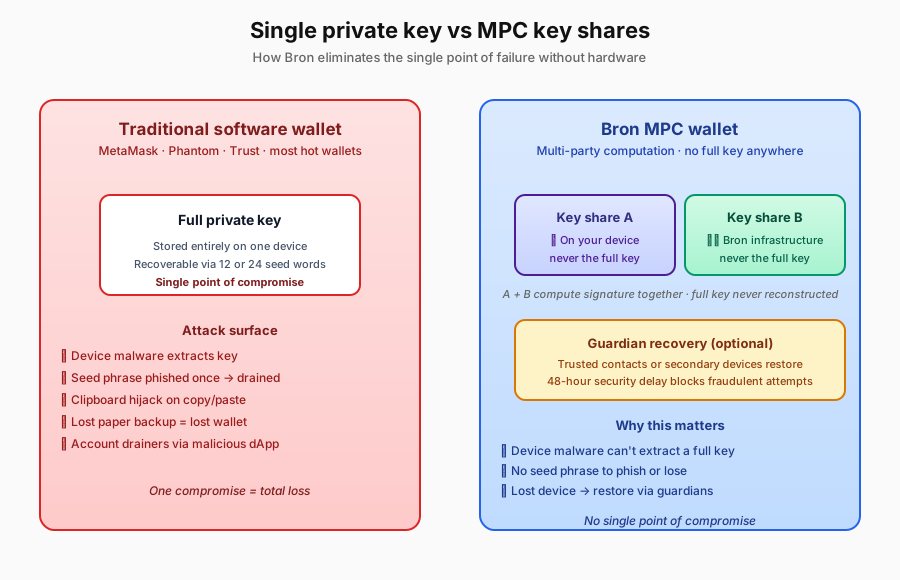
🔐 How MPC actually works (in plain language)
MPC stands for multi-party computation. It's a cryptographic technique that lets two or more parties jointly compute a function over their inputs while keeping each party's input private from the others.
For a crypto wallet, the function is signing a transaction. The inputs are shares of a private key. The privacy guarantee is no party ever sees the full key.
In Bron's case, when you create a wallet:
-
Key generation happens in two places at once. Your device generates a key share. Bron's infrastructure generates a complementary key share. The two shares together correspond to a wallet address on Ethereum, Solana, or another chain — but the full private key is never assembled.
-
When you sign a transaction, both shares compute the signature collaboratively. Your device proves it has share A, Bron's infrastructure proves it has share B, and the signature is produced through a multi-round cryptographic protocol. Even during this process, the full key is never reconstructed in memory anywhere.
-
An attacker would need both shares simultaneously to forge a signature. Compromising your device alone is not enough. Compromising Bron's infrastructure alone is not enough. The attacker would need a coordinated compromise of both, which is mathematically and operationally much harder than the single point of failure traditional wallets present.
The cryptographic primitives behind MPC have been studied in academic literature since the 1980s and used in institutional digital-asset custody for years. Bron is the first widely-distributed consumer wallet that brings the same architecture to a polished user-facing product.
🛡️ Guardian recovery + 48-hour security delay
The recovery model is what makes the seedless approach actually viable. If there's no seed phrase, there has to be another way to restore access when you lose your device or delete the app.
Bron's recovery flow uses guardians — trusted contacts or your own secondary devices designated during setup. To recover access:
- You initiate a recovery from a new device using your email
- Your designated guardians receive a verification request
- Once enough guardians approve, the recovery begins
- A mandatory 48-hour security delay runs before recovery completes
- During the 48-hour window, you receive notifications on all your registered devices and can cancel any recovery you didn't authorise
- If no cancellation happens, the new device receives a fresh key share paired with Bron's complementary share — your wallet is restored
The 48-hour delay is the most important design decision in the entire recovery flow. Without it, the failure mode would be social engineering on guardians — an attacker who compromises a few of your trusted contacts could initiate a fraudulent recovery and drain your wallet within minutes. With it, you have two full days to detect the attempt through notifications and stop it.
For everyday users this trade-off is the right one. A 48-hour wait on legitimate recovery is mildly inconvenient. A 48-hour wait that prevents a successful takeover attack is a wallet-saving feature.
👥 Who's behind Bron — the Copper.co credibility
The team matters more for an MPC wallet than for most other crypto products, because MPC is genuinely hard to implement correctly. The cryptography is well-understood; the engineering details (key generation protocols, signing flow, recovery design, backup procedures) require real specialist expertise.
Bron is built by the team behind Copper.co, led by Dmitri Tokarev, one of the pioneers in institutional digital-asset custody. Copper.co serves hedge funds, asset managers, and trading firms — clients who require MPC-based cold storage, audited custody operations, and pressure-tested signing infrastructure. The same engineering muscle that built that institutional product is now behind Bron's consumer wallet.
This matters in two specific ways:
- MPC implementation quality — the team has spent years refining the exact protocols Bron now uses for retail customers
- Operational maturity — running coordination infrastructure with high uptime, key-management procedures, incident response — these are operational disciplines you can't fake, and the Copper.co background means they're already in place
It's not a guarantee of zero issues forever, but the credibility floor is meaningfully higher than for a typical "new wallet on Product Hunt."
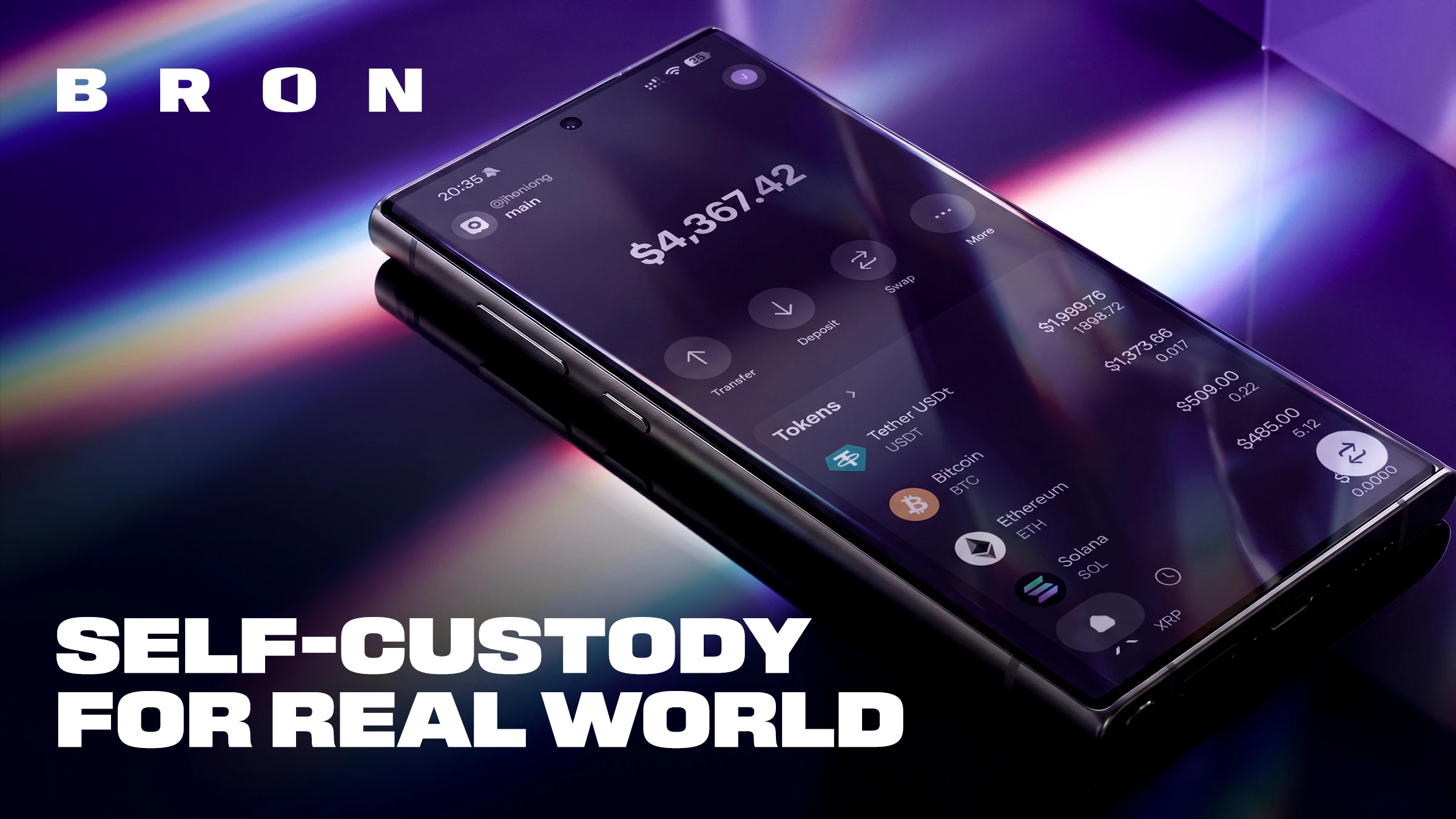
📲 What the Bron app actually looks like
The onboarding flow is what immediately tells you this is built for non-crypto-native users:
- Enter your email
- Receive a 6-digit confirmation code
- Wallet dashboard opens — no seed phrase prompt, no "save these 24 words" screen
- Add guardians (trusted contacts or secondary devices) for recovery
- Start funding the wallet
That's it. Compare to a typical hardware wallet onboarding (unbox, install software, generate seed, write down 24 words, verify each word, set PIN, set passphrase, store paper in fireproof location) and the UX gap is enormous.
Features available in the wallet:
- In-wallet exchange — swap between supported tokens without leaving the app
- Fast recovery — guardian-based with the 48-hour delay
- Secure token custody — MPC-protected balance storage
- Staking — earn yield on supported assets directly inside the wallet
Important caveat: not all features are available in the browser version. To use the in-wallet exchange and staking, you need to install the desktop version. The web app is good for monitoring balances and quick transactions; the desktop app is the full experience.
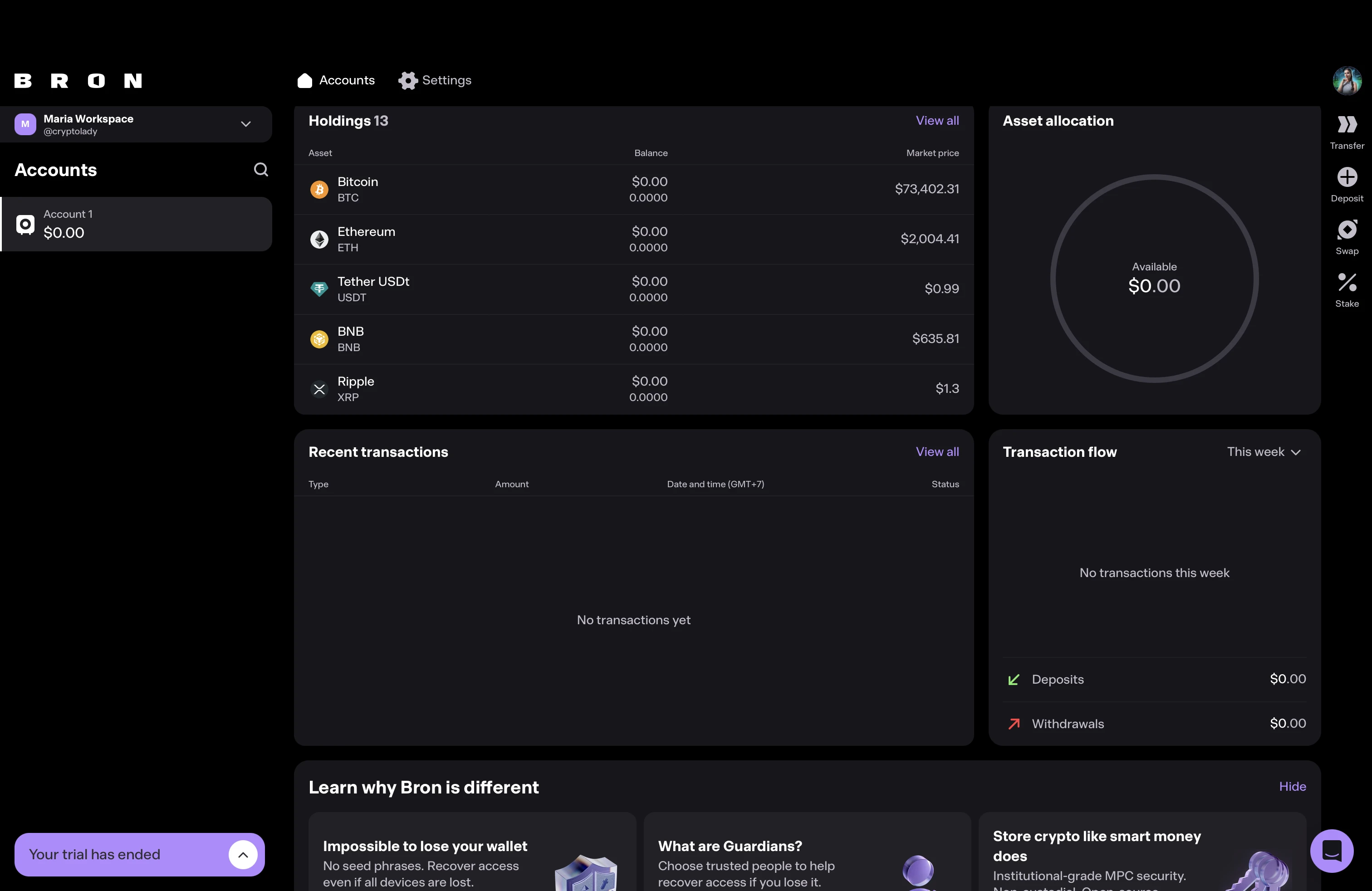
The screenshot above shows the actual desktop interface — Holdings list on the left (BTC, ETH, USDT, BNB, XRP), Asset allocation pie chart on the right, Recent transactions and Transaction flow below, plus educational blocks like "What are Guardians?" and "Store crypto like smart money does" embedded directly into the dashboard. The UI density is closer to a fintech app (Revolut, Wise) than a crypto wallet — deliberate design choice for the non-crypto-native audience Bron targets.
💎 Subscription tiers — two payment paths, fully honest breakdown
Bron has four paid tiers — Basic, Pro, Enterprise, Founders Club — and offers two ways to pay for any of them: hold $BRON tokens as a stake, OR a straightforward fiat subscription. Most reviews skip the fiat option and frame everything around the token. I'll show you both so you can pick the one that makes sense for your situation.
Option 1 — Hold $BRON (token-tier model)
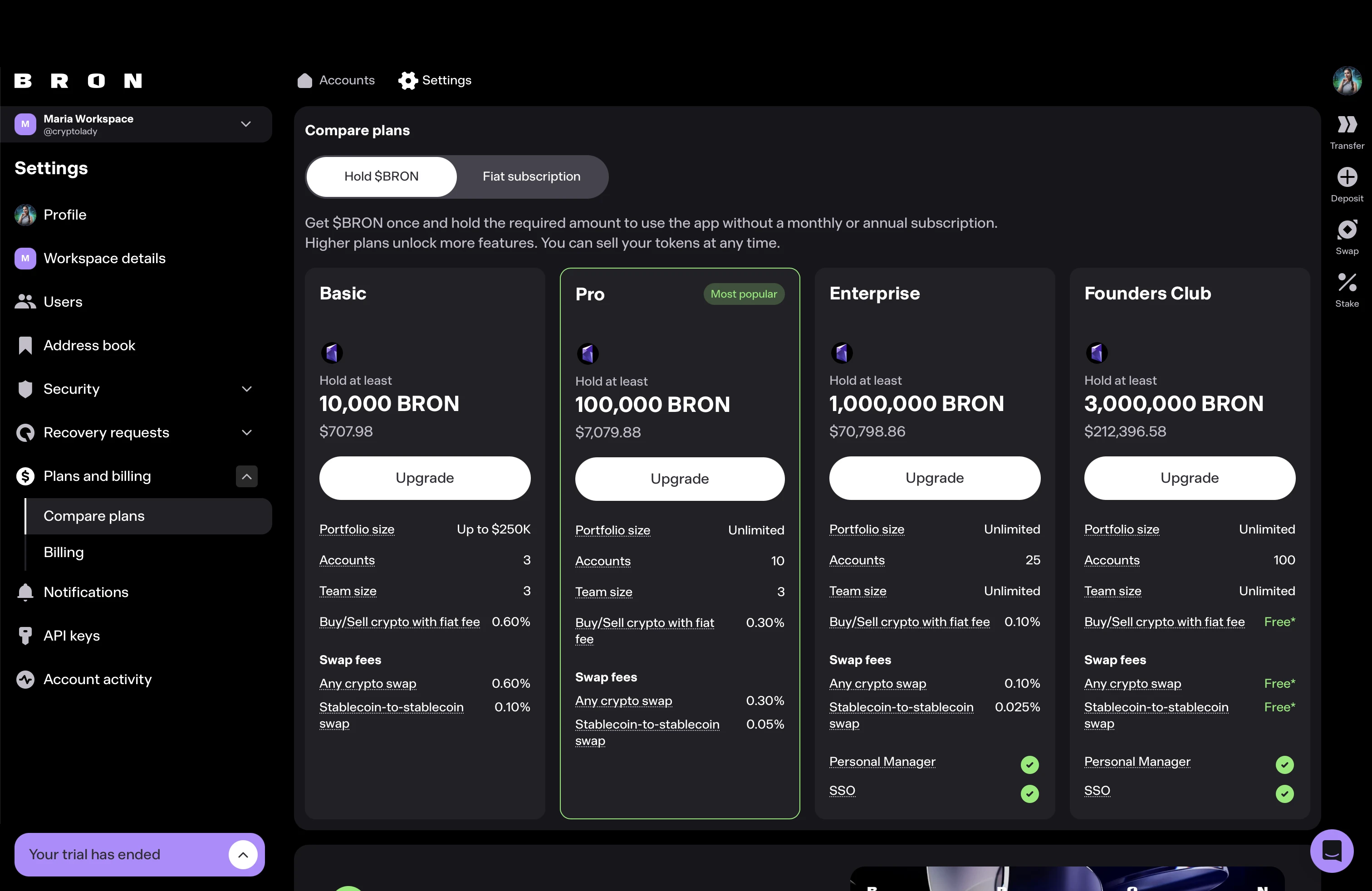
The token-tier model: instead of monthly payment, you hold a specific amount of BRON in your wallet and keep that tier active as long as you hold. You can sell the tokens at any time and the tier drops.
| Tier | Hold requirement | USD value at current price |
|---|---|---|
| Basic | 10,000 BRON | ~$708 |
| Pro (most popular) | 100,000 BRON | ~$7,080 |
| Enterprise | 1,000,000 BRON | ~$70,797 |
| Founders Club | 3,000,000 BRON | ~$212,395 |
Option 2 — Pay in fiat (monthly subscription)
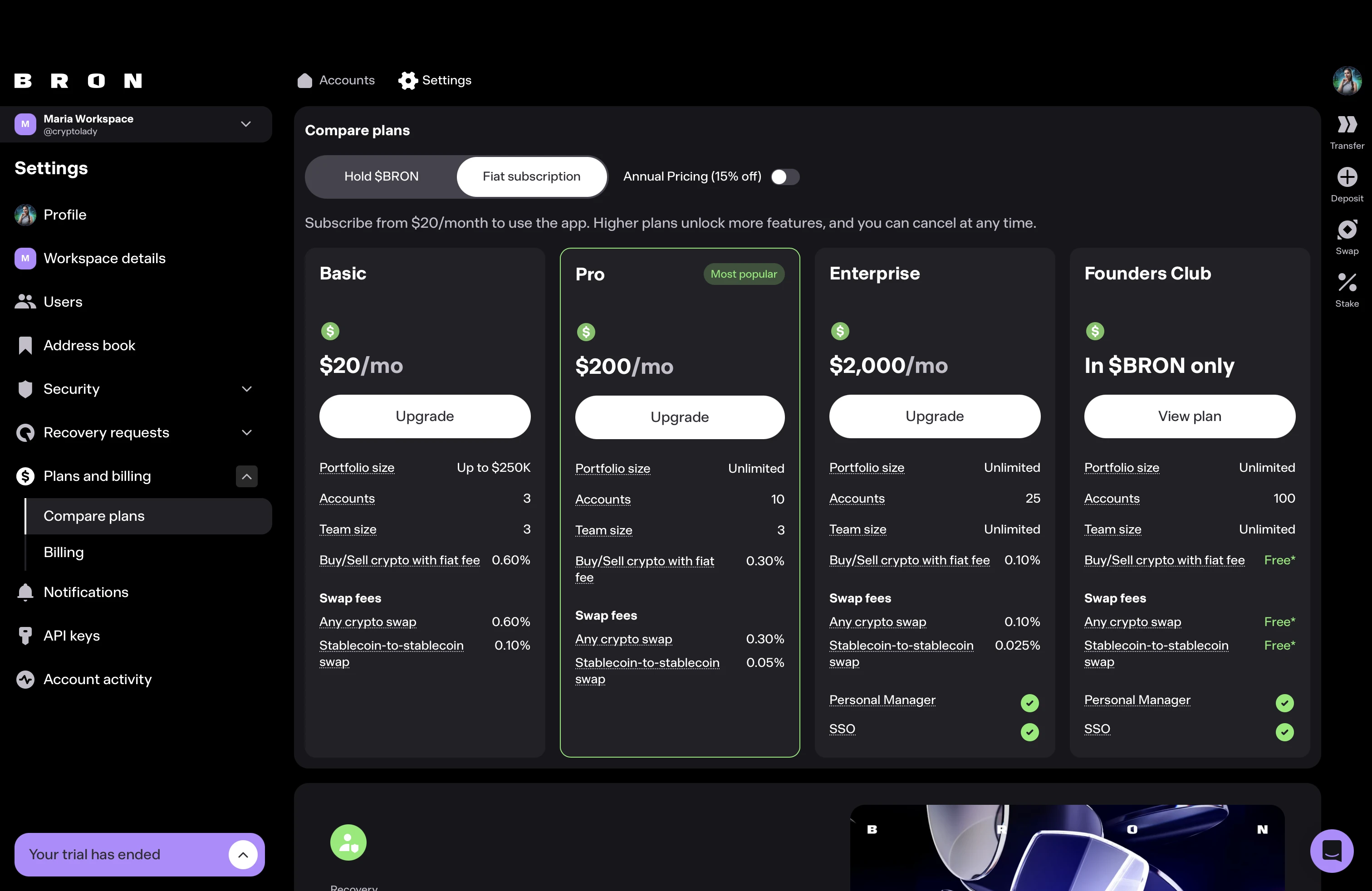
If you don't want exposure to BRON token price movements, the fiat option works the same — same features, monthly billing. Annual pricing has 15% off.
| Tier | Monthly | Annual (15% off) |
|---|---|---|
| Basic | $20/mo | ~$204/yr |
| Pro | $200/mo | ~$2,040/yr |
| Enterprise | $2,000/mo | ~$20,400/yr |
| Founders Club | $BRON only | — |
The Founders Club tier is intentionally only accessible via BRON tokens — it's positioned as the "skin in the game" tier for users who specifically want long-term alignment with the project.
What each tier actually unlocks
| Feature | Basic | Pro | Enterprise | Founders Club |
|---|---|---|---|---|
| Portfolio size | Up to $250K | Unlimited | Unlimited | Unlimited |
| Accounts | 3 | 10 | 25 | 100 |
| Team size | 3 | Unlimited | Unlimited | Unlimited |
| Buy/Sell crypto fee | 0.60% | 0.30% | 0.10% | Free |
| Crypto-to-crypto swap fee | 0.60% | 0.30% | 0.10% | Free |
| Stablecoin-to-stablecoin swap | — | 0.05% | 0.05% | Free |
| Personal Manager | — | — | ✅ | ✅ |
| SSO | — | — | ✅ | ✅ |
Token-vs-fiat math — when does each make sense?
Pay in fiat if:
- You don't want exposure to BRON token price volatility
- You're testing the wallet and might cancel anytime
- The subscription cost is small versus your portfolio (Basic at $20/mo = $240/yr, trivial for anyone holding $50K+)
Hold $BRON if:
- You believe in the project long-term and want potential token upside
- You're committing for years (Pro at 100,000 BRON ≈ $7,080 ties up capital but stays "yours")
- You want the Founders Club tier (only accessible via tokens)
Honest framing on the BRON token itself:
- It's a utility token that unlocks tier features — that's its primary role
- It's not equity in the company, doesn't pay yield, and doesn't generate revenue share
- Token price can drop — if your "Pro tier hold" worth $7,080 today drops to $3,000, you may fall below threshold and lose tier access
- The fiat option exists precisely so users who don't want this exposure aren't forced into it
Evaluate the subscription the way you'd evaluate any SaaS — does the feature set justify the price for your portfolio size and team? For most retail users with portfolios under $250K, Basic at $20/mo is the right starting point.
⚠️ Trade-offs and limitations to keep in mind
Being honest about where Bron loses to other architectures matters more for an "education-first" review than another marketing-speak puff piece. The trade-offs:
1. "No seed phrase" doesn't mean "no responsibility." You still need to keep your guardians secure (don't pick someone who'll be social-engineered easily), your email account protected (2FA mandatory), and your secondary devices unstolen. The responsibility shifts but doesn't disappear.
2. MPC depends on Bron's infrastructure remaining operational. Self-custody with a hardware wallet and a seed phrase is fully sovereign — you can sign transactions even if the entire crypto industry goes offline. MPC wallets require the coordination layer (Bron's side) to be online for signing. Bron publishes contingency plans for prolonged downtime, but this is a real trade-off versus fully offline cold storage.
3. Browser version is feature-limited. Exchange and staking require the desktop app. If you primarily use crypto from a browser, this is a friction point.
4. Token tiers vs fiat tiers — same features, very different commitments. The four tiers (Basic / Pro / Enterprise / Founders Club) are accessible via either holding BRON tokens or paying fiat subscription. Same unlocks, two payment paths. Pick fiat if you want zero token-price exposure; pick BRON if you believe in long-term project alignment. The Founders Club is intentionally BRON-only. Don't sleep-walk into the token route assuming it's the only option — most reviews skip this.
5. Test with small amounts first. This applies to literally any new wallet, but doubly so for any wallet built on a less-than-decade-old architecture. Move $50 in. Test sending, receiving, swapping, recovery flow on a secondary device. Only then scale up balance.
🆚 Bron MPC vs Ryder Shamir vs traditional seed phrase
The two seedless approaches in 2026 are MPC (Bron) and Shamir's Secret Sharing on hardware (Ryder). They solve the same problem — the single-point-of-failure of a 12 or 24-word seed phrase — but with different architectures. Here's the head-to-head:
| Property | Bron (MPC) | Ryder (Shamir + hardware) | Traditional seed phrase |
|---|---|---|---|
| Where the key lives | Two shares — your device + Bron infrastructure | Fragments across phone, NFC tags, optional guardians | Full key on one device + paper backup |
| Recovery method | Guardians + 48h security delay | Tap phone + recovery tag | Find the paper you hid |
| Onboarding | Email + confirmation code | Buy device + set up tags | Buy device + write 24 words |
| Internet required for signing | Yes (for MPC coordination) | No (signing happens on-device) | No (signing happens on-device) |
| Best for | Active daily balances, DeFi, swaps | Cold storage of meaningful capital | Power users who refuse external dependencies |
| Failure mode | Bron infrastructure down + recovery contingency needed | Multiple physical backups lost simultaneously | Single paper lost / phished |
| Setup time | Under 2 minutes | 15-30 minutes (hardware unboxing + setup) | 15-45 minutes (write + verify words) |
Practical pairing for most users: Bron for active daily balance (fast UX, in-wallet swap, easy recovery) + a hardware wallet like Ryder or Trezor for long-term cold storage of size. Different tools for different jobs.
🎯 Who Bron is for?
| Profile | Verdict |
|---|---|
| New to crypto, friction-averse | Strong fit — fastest seedless onboarding I've seen |
| Existing MetaMask user tired of seed phrase paranoia | Strong fit — direct upgrade for daily-use balance |
| Active DeFi user wanting fewer signing steps | Good fit — in-wallet swap saves significant clicks |
| Long-term HODLer with significant capital | Use as complement to hardware wallet, not primary |
| Self-sovereignty maximalist | Skip — MPC's dependency on Bron's coordination layer is the wrong trade-off for your threat model |
| Bitcoin-only purist | Skip — Bron is multichain-focused, Bitcoin tooling isn't where it shines |
The strongest case for Bron is the user who would otherwise default to MetaMask or Trust Wallet for active crypto activity. Bron does the same job — non-custodial wallet for daily use — with materially better recovery design and no seed phrase to lose.
The strongest case against Bron is the user who's already moved beyond hot wallets entirely and uses hardware for everything. Bron isn't trying to replace that workflow — it's improving the hot-wallet side.
💡 Verdict
Bron is the most polished consumer MPC wallet I've seen in 2026. The onboarding is the smoothest in the seedless category — email + code, no paper, no anxiety. The team behind it has real institutional custody background (Copper.co, Dmitri Tokarev), which materially raises the credibility floor versus typical "new wallet" launches. The 48-hour security delay on recovery is exactly the right design for a guardian-based system.
The trade-offs are honest ones: MPC depends on Bron's coordination layer remaining operational; the desktop version has more features than the browser; the Bron token is utility, not investment. None of these are deal-breakers for the use case Bron is targeting — they're disclosed design decisions, not hidden gotchas.
If you're tired of writing 24-word phrases on paper and hiding them, this is worth setting up and testing with a small balance.
🔐 Sign up to Bron via my partner link — affiliate disclosure above.
📺 Full video walkthrough on YouTube
📚 Official Bron resources:
- bron.org — main site, downloads, documentation
- Bron support center — recovery procedures, troubleshooting
- Bron on X — product updates and announcements
📚 Related articles:
- Best hardware wallet 2026 — ERA vs Ryder vs Ledger vs Trezor — the full comparison if you'd rather hold keys on a device
- Ryder Wallet review 2026 — the hardware seedless alternative (Shamir's Secret Sharing)
- ERA Wallet review 2026 — for blind-signing protection on existing seed phrases
- Bybit security checklist 2026 — exchange-side security companion
- Crypto cards 2026 — full comparison — spending tools after you've secured your custody stack
Register via my link
Sign up to Bron via my partner link
Frequently asked
What actually happens to my private key in an MPC wallet?+
Your private key is never generated as a single piece of data anywhere. Instead, two cryptographic shares are created — one stored on your device, one on Bron's infrastructure. Each share alone is mathematically useless. When you sign a transaction, the two shares compute the signature together through a protocol called multi-party computation, but the full key is never reconstructed in one place at any point. This eliminates the single point of compromise that traditional wallets have.
How is Bron different from a non-custodial wallet like MetaMask?+
MetaMask stores your full private key locally, encrypted by your password, with a 12-word seed phrase as the only recovery path. If malware extracts that key file, your phrase is phished, or you lose the paper — your wallet is gone. Bron's MPC architecture means there's no full key on your device to extract, no seed phrase to phish, and the guardian-based recovery flow works even if you lose your device entirely. Both are non-custodial in that Bron can't unilaterally move your funds, but the failure modes are very different.
Who is Dmitri Tokarev and why does the Copper.co background matter?+
Dmitri Tokarev founded Copper.co, one of the major institutional digital-asset custody providers, used by hedge funds and asset managers for cold storage and trading infrastructure. The Bron team brings institutional MPC and custody expertise to a consumer product. This matters because MPC is hard to implement correctly — the cryptography is well-understood, but the engineering details (key generation, signing protocol, recovery flow) require real expertise. A team with institutional custody background has been pressure-tested on those exact problems for years.
What is the 48-hour security delay and why does it matter?+
When someone initiates a recovery flow on your account, Bron enforces a mandatory 48-hour delay before the recovery can complete. During this window you receive notifications and can cancel any recovery you didn't authorise. The delay exists because the most dangerous attack on guardian-based wallets is a coordinated social-engineering attempt — someone convinces enough of your guardians to approve a recovery to a new device. The 48-hour window gives you time to detect and stop it. It's a deliberate trade-off — slightly slower legitimate recovery in exchange for resilience against takeover attempts.
Does Bron actually work offline if Bron's servers go down?+
Partially. Day-to-day signing requires both shares to compute together, so Bron's coordination infrastructure being online is part of the signing path. Bron publishes a contingency plan for prolonged downtime that allows you to extract your share and reconstruct keys through documented recovery procedures. This is a meaningful difference from fully sovereign self-custody (hardware wallet with seed phrase you control entirely) — MPC wallets depend on the issuer's design and uptime. For most users this trade-off is acceptable, but it's the single most important thing to understand before depositing significant capital.
What's the Bron token actually for, and do I have to buy it?+
No, you don't have to buy it. Bron offers two payment paths for the same four tiers (Basic / Pro / Enterprise / Founders Club) — you can either hold BRON tokens as a stake (10K / 100K / 1M / 3M BRON depending on tier) OR pay a regular fiat subscription ($20 / $200 / $2,000/mo with 15% off annually). The Founders Club is the only tier that requires tokens. The BRON token is pure utility — it unlocks the same tier features as fiat does, plus it gives long-term holders potential price upside if the project grows. Don't conflate 'hold tokens to unlock features' with 'buy tokens for investment.' If you don't want exposure to BRON price movements, the fiat path is right there.
Should I use Bron, a hardware wallet like Ryder, or both?+
Different tools for different jobs. Bron MPC is excellent for active daily-use balances — fast onboarding (email + code, no seed phrase to write down), guardian recovery, in-wallet swap and staking. Hardware wallets like Ryder are better for cold storage of meaningful capital — the keys live on dedicated hardware never connected to the internet during signing. A common pattern: small active balance on Bron for daily activity (DeFi, swaps, payments), larger long-term holdings on a hardware wallet. Both can use guardian-style or distributed recovery, both are seedless — but the threat models are different.
Want a review like this for your project?
YouTube review + Telegram + an evergreen blog article — EN · ES · RU-CIS markets. Real audience, verifiable results.